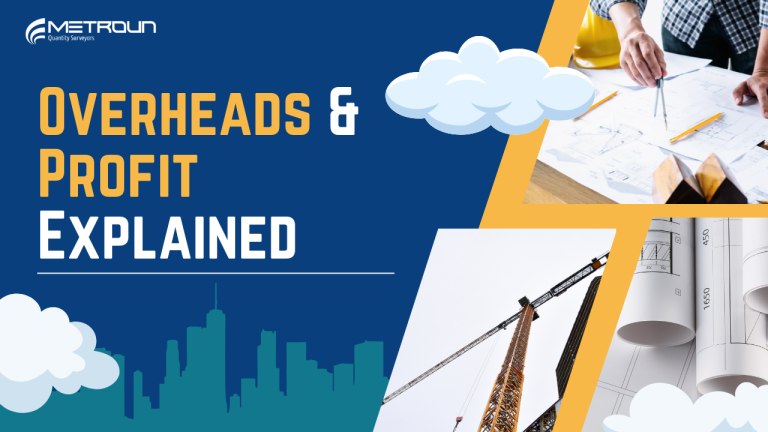
When thinking of the cost to complete a construction project, your mind is immediately drawn to the obvious stuff, like materials, labour & equipment to carry out the work. But we also know that’s not the full picture. Preliminaries, business overheads, and profit all form part of the equation. In this article, we’re going to delve deeper into overheads & profit. How they form part of the indirect cost of a project, what’s included within them and some common misunderstandings about them.
Overheads
Put simply, overheads are the costs of running the business that are not directly linked to one specific measured item of work. So if a contractor is building a wall, the bricks, mortar and labour are direct costs. But the cost of the business staff, head office rent, IT systems and general business insurance would usually sit within overheads. These are real costs that still need to be recovered somewhere in the price.
Profit
Then there is profit. Profit is the return a contractor hopes to make after covering its costs. It is the reward for taking on the job, using its expertise, tying up resources and accepting risk. Without profit, there is very little commercial reason for a contractor to take on work. You’ll often find profit margins in construction are small (often between 2 and 5%), and one erroneous commercial practice resulting in an unapproved variation can absorb all your margin and then some in one go. This is why having a competent QS who understands the contract, risk management & commercial practices can protect your company from loss.
Metroun LearningShort courses with structured CPD, 20 minutes eachStart ›Overheads & Profit
People often hear the phrase overheads and profit and treat it like one thing. In practice they are often shown together as one percentage, but they are not the same. Overheads are about recovering the wider cost of running the business. Profit is about making a return on top.
Not all indirect cost is overhead. However, all overheads are indirect costs. Some indirect costs are project specific and usually dealt with as preliminaries. Other indirect costs are business wide, and those are usually head office overheads.
So where do overheads and profit actually appear in pricing? Very often, they are added as a percentage on top of the cost of the works. But the percentage is not fixed across the industry. It will vary depending on the market, the level of competition, the risk profile of the project, the procurement route and the contractor’s strategy.
This is why two contractors can look at the same job, have similar direct costs, and still return different prices. One may allow more for business recovery. Another may trim profit to secure the work. Another may increase its allowance because the scheme is high risk or resource intensive.