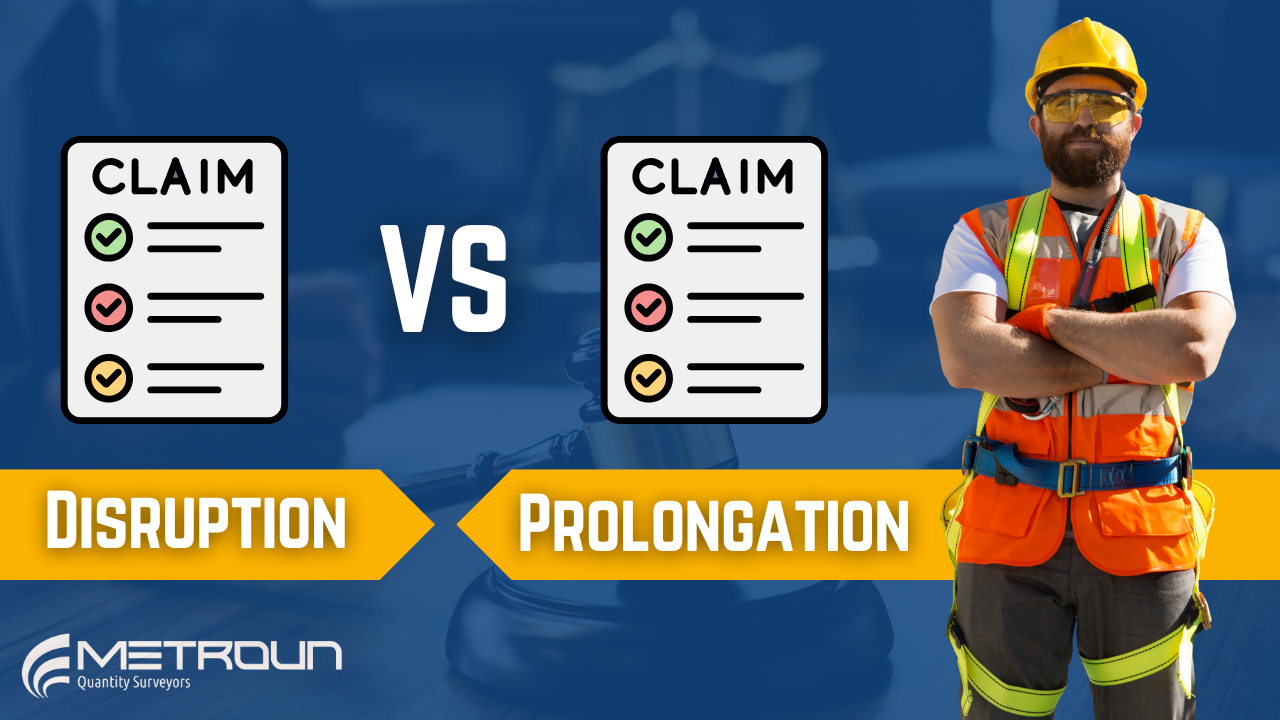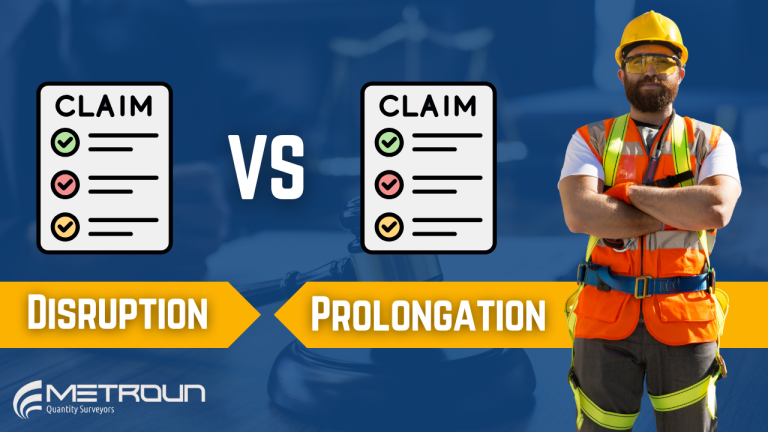
You’ve probably come across the terms prolongation or disruption when dealing with claims. Whether you are a client QS reviewing claims, or a contractor submitting them, being able to distinguish between the two is essential.
In this article, we’ll investigate how they differ, what types of costs are included in both and what events lead to them arising in the first place.
Prolongation Claims
Throughout a construction project there are site specific overheads, known as preliminaries, which are required for construction activities. They include items such as security, welfare and temporary works. Much of what makes up preliminaries are time related costs, meaning if the completion date is pushed back, the cost for these items increases. Submitting a claim for these increases is known as a prolongation claim. Prolongation means “the extension of the duration of something”, in this case, the overall programme. These claims reimburse the contractor for the additional indirect cost on a project resulting from an extension to the programme. However, prolongation claims are not just limited to preliminaries, they can include time related resource used on site such as plant on hire, subcontractor prolongation costs, head office overheads and professional fees.
Some examples of prolongation claims include:
- Late approvals holding up a critical activity.
- A design change affecting the critical path.
- Unforeseen ground conditions pushing back programme milestones.
Disruption Claims
Disruption claims on the other hand relate to events which reduce the efficiency of works but do not extend the overall duration of the project. For example, there may be certain activities which took longer than planned but were not on the critical path, and as such didn’t extend the overall programme. Or, you might have a circumstance where additional resource was required to finish a task.
Disruption claims include costs arising from lost efficiency, resequencing, working around others, stop start working, access restrictions, late information and design changes. However, they do not include costs related to adding time onto the programme.
Some examples of disruption claims include:
- Constant change to working areas.
- Working alongside other trades you didn’t expect.
- Breaking out works twice.
- Waiting on late permits or drawings but still pushing on.
Disruption claims can come with challenges and are sometimes harder to ascertain than prolongation claims. According to RICS “This can be more challenging for disruption claims as it can be difficult to attribute loss of productivity to a particular relevant matter, although good site records often help to manage this issue.”
So that gives you an overview of the main differences. An easy way to remember the difference is to understand that disruption is when “you’re working but not as efficiently” as opposed to prolongation where “you’re delayed and the overall project is taking longer”.