
On June 20th, 2018, at a seminar in London, NEC introduced the NEC4 Alliance Contract—a groundbreaking multiparty agreement designed to reshape collaboration on major projects and programs. Unlike traditional contracts, this model places collaboration at the heart of project delivery, uniting clients and suppliers under a single agreement.
For organisations managing large, multidisciplinary, or long-term projects, the NEC4 Alliance Contract offers a framework built on shared risks, shared rewards, and a genuine spirit of partnership.
A New Era of Collaboration
While NEC contracts have always emphasised collaboration, the NEC4 Alliance Contract takes this concept further, creating a “true alliance”. All parties—clients, consultants, contractors, and suppliers—work together toward common goals with equal voices in decision-making.
Metroun LearningLearn NEC properly: 24 short courses, structured CPDStart ›Key differences from earlier contracts include:
- In previous NEC versions, collaboration often relied on optional clauses like X12, which encouraged multiparty working.
- In NEC4, collaboration is no longer optional. It is built into the contract’s structure, ensuring that all parties are aligned from the outset.
This shift is designed to reduce disputes, align interests, and improve project outcomes.
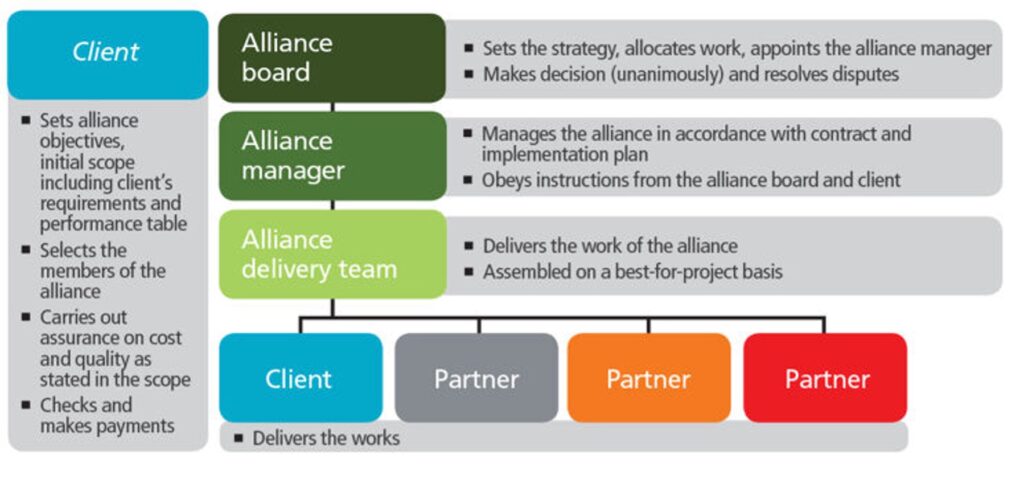
Structure of the NEC4 Alliance Contract
The NEC4 Alliance Contract is structured around three key groups:
1. The Alliance Board
- Made up of client and tier 1 contractor representatives (the defined “partners”).
- Responsible for strategy, allocating work, appointing the Alliance Manager, and acting as the first point of referral for disputes.
- Decisions must be unanimous, with each partner holding equal voting rights.
2. The Alliance Manager
- Functions similarly to the project manager role in other NEC contracts.
- Oversees day-to-day operations and ensures compliance with the contract and implementation plan.
- Takes direction from the Alliance Board.
3. The Alliance Delivery Team
- Includes the client and all partners responsible for delivering project work.
- Partners may consist of designers, civil contractors, and equipment suppliers, forming the tier 1 supply chain.
An important distinction is the client’s dual role: they actively participate as a partner within the alliance while also holding certain powers outside it.
Decision-Making and Disputes
The contract emphasises unanimous decision-making by the Alliance Board. Disputes are expected to be rare and only arise under exceptional circumstances, such as serious contractual breaches. This design ensures that claims and conflicts are handled collaboratively rather than adversarially.
Conclusion
The NEC4 Alliance Contract represents a bold step forward for collaboration in the construction industry. By aligning clients and suppliers within a single contractual framework, it encourages shared responsibility, transparent governance, and unified delivery of project objectives.
For anyone working on complex or long-term projects, this model offers a pathway to stronger partnerships and better results.
👉 Want to see how payment processes work under the NEC4 Alliance Contract? Read our detailed article here: NEC4 Alliance Contract Payments